The Old Forester Tribute Series 2026 inaugural 12 Year decanter has barely reached store shelves, yet early secondary-market sales are already averaging $715. We examine the whiskey, the history behind the release, and whether its substantial premium is sustainable.
The Old Forester Tribute Series 2026 has entered the ultra-premium bourbon conversation with a 12-year-old, 115-proof Kentucky straight bourbon presented in a distinctive collectible decanter. Released in October with a suggested retail price of $299.99, the inaugural edition is already attracting considerable attention from collectors.
Early completed secondary-market sales tracked by Bourboneur® are averaging approximately $715, representing a 138% premium over retail. That’s an impressive opening for a bourbon that has only recently begun reaching consumers, although early pricing can be particularly volatile.
I was fortunate enough to secure two bottles through a Total Wine pre-order at approximately $300 each. With secondary values already more than double that amount, the release presents an interesting question: are collectors paying for exceptional whiskey, the beginning of a new collectible series, or some combination of the two?
Old Forester has an established reputation for highly sought-after releases, including Birthday Bourbon, President’s Choice, and the 117 Series. The Tribute Series takes a different approach, combining mature bourbon with a presentation inspired by the brand’s historical decanters.
The inaugural release draws inspiration from Old Forester’s decorative holiday decanters, first introduced in 1950. During the following decades, the distillery produced distinctive designs that positioned bourbon as both a premium spirit and a collectible gift. The modern Tribute decanter revisits that tradition through architectural glasswork, vertical facets, metallic accents, and a substantial stopper.
This is clearly a bottle designed to be displayed as well as enjoyed. Its presentation is part of the value proposition, and with Old Forester planning annual editions, the 2026 release carries the additional distinction of being the first in the series.
Whether that inaugural status translates into lasting collectible value remains to be seen. Much will depend on the quality of subsequent releases, future production volumes, and whether the series develops a dedicated following among collectors.
For additional background, see Old Forester’s official Tribute Series announcement.
Fortunately, the Tribute Series appears to offer more than attractive packaging. The inaugural edition is a 12-year-old Kentucky straight bourbon bottled at 115 proof, or 57.5% alcohol by volume, using Old Forester’s traditional mash bill of 72% corn, 18% rye, and 10% malted barley.
The whiskey was matured in Old Forester’s heat-cycled warehouses, where winter heating encourages continued interaction between the spirit and its oak barrels. This approach is a defining characteristic of the distillery’s maturation philosophy and can contribute to concentrated sweetness, mature oak, and pronounced spice.
Unlike a single-barrel release, Tribute is a batched bourbon assembled from selected mature barrels to achieve a particular flavor profile. That distinction is worth understanding because the emphasis is on the finished whiskey rather than the individual characteristics of a specific barrel.
Old Forester has indicated that future editions will carry age statements and be bottled between 110 and 125 proof, giving the distillery flexibility to select and blend whiskey for each annual release.
The published tasting profile suggests that Old Forester has leaned into the characteristics enthusiasts often seek in mature Kentucky bourbon: concentrated fruit, developed oak, and layered baking spices.
Aroma: Old Forester describes warm caramel, sweet leather, golden raisins, and dark cherries. The combination suggests a rich, mature nose, with darker fruit notes providing balance against the deeper oak influence expected from 12 years of maturation.
Palate: Cherry cola and candied walnuts lead the official description, followed by cinnamon and cardamom. That cherry-cola character is particularly appealing because it connects the familiar fruit-driven Old Forester profile with the richer flavors associated with extended aging.
Finish: Toasted oak, cracked peppercorn, cherry preserves, and black tea round out the experience. The profile points toward a structured finish where lingering fruit sweetness competes with drying oak and spice.
Independent early reviews have been encouraging. In his October 15 review for Forbes, David Thomas Tao highlighted the bourbon’s dark fruit, pastry-like richness, cherry cola, and mature oak. His principal reservation was that the finish could be somewhat oak-forward for drinkers who prefer a sweeter, less tannic bourbon.
That observation is important. A 12-year age statement doesn’t automatically produce a better whiskey, particularly when extended barrel contact can introduce bitterness or excessive dryness. The most promising aspect of Tribute’s early reception is that the bourbon appears to retain substantial fruit character despite its maturity.
These tasting observations are based on Old Forester’s published tasting notes and independent reviews rather than a completed Bourboneur tasting. While the early reception is favorable, a firsthand evaluation would provide a better basis for judging the whiskey’s quality relative to its price.
The financial side of this release is difficult to ignore. At approximately $715, the early secondary market is valuing the Tribute Series at nearly 2.4 times its original retail price, creating a substantial difference between what fortunate retail buyers paid and what collectors are currently spending to secure a bottle.
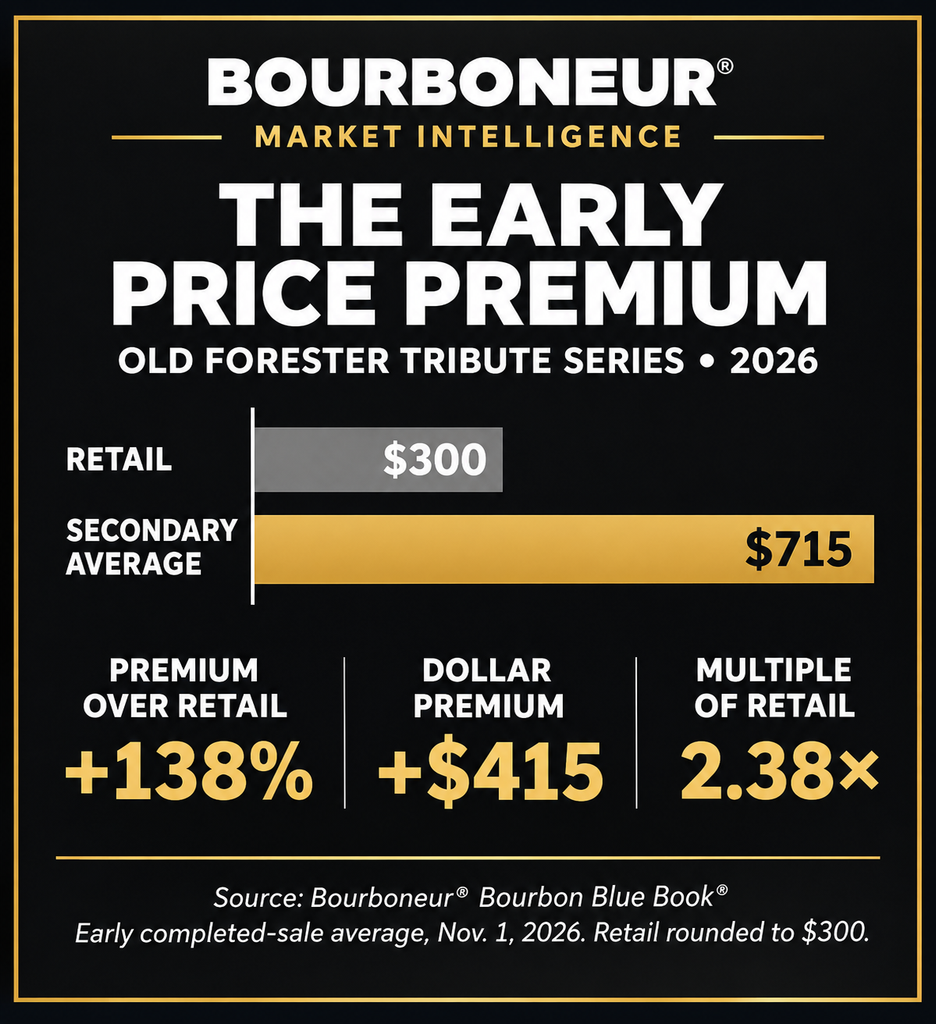
For someone purchasing at retail, that represents an immediate increase in implied market value. Two bottles acquired for approximately $600 would carry a combined indicative secondary value of $1,430 at today’s average, an $830 difference before taxes, fees, or other expenses.
However, these numbers should be viewed in context. The Tribute Series is still entering distribution, and early transactions may reflect buyers willing to pay a premium to secure a bottle before broader availability. As additional inventory reaches the market, prices could change substantially.
This is precisely why completed-sale data matters. Asking prices can reflect a seller’s expectations, but verified transactions provide a more useful indication of what collectors are actually willing to pay.
The next several weeks could tell us considerably more about the Tribute Series than its earliest transactions. Initial demand appears strong, but demand and scarcity are not necessarily the same thing, particularly when retail distribution is still underway.
There are several reasonable outcomes. Prices could decline as more bottles become available and the initial urgency subsides. Alternatively, the combination of strong reviews, distinctive packaging, and inaugural-edition status could support a sustained premium over retail.
A longer-term collectible premium is also possible if the Tribute Series develops a following and collectors begin seeking complete annual sets. However, that argument depends on future demand that has not yet been established.
One important unknown is production volume. Without a disclosed bottle count, it’s difficult to determine how scarce this inaugural release will ultimately be. Limited availability during the first weeks of distribution should not automatically be interpreted as permanent scarcity.
For now, the $715 average is best understood as an early market signal rather than an established long-term valuation. The direction of future prices will depend on how supply and demand develop after the initial release period.
At retail, the Tribute Series represents a premium purchase for a 12-year-old, high-proof bourbon from a respected Kentucky producer. Its packaging and early reviews add to the appeal, although $300 remains a meaningful price for a bottle intended primarily for drinking.
At $715, the calculation changes. Buyers are paying not only for the whiskey but also for the perceived rarity, presentation, inaugural status, and potential future desirability of the release.
That doesn’t necessarily make the secondary valuation unreasonable. Collectors have always assigned value to characteristics beyond the liquid itself, and first editions can become particularly desirable when a series establishes a lasting following.
The distinction is between buying a bourbon to enjoy and buying one to collect. For the drinker, the question is whether the experience justifies the premium. For the collector, it’s whether that premium can be maintained as more bottles enter circulation and subsequent editions are released.
Those are two different propositions, and the Tribute Series is currently asking buyers to consider both.
The Old Forester Tribute Series 2026 has several attributes working in its favor. It’s the inaugural edition of a new annual collection from an established producer, carries a meaningful 12-year age statement, delivers 115 proof, and arrives in packaging deliberately designed to appeal to collectors. Early independent reviews also suggest the whiskey itself deserves attention.
At approximately $715, however, the secondary market is assigning a substantial premium to a bottle with a very limited pricing history. That doesn’t mean the current valuation is necessarily excessive, but it does mean collectors should be cautious about assuming the early average represents a sustainable price.
For those who secured bottles at retail, the release has already delivered an encouraging start from a market-value perspective. For buyers considering secondary-market purchases, allowing distribution to mature may provide a clearer picture of both availability and demand.
As for my two bottles, the early market performance certainly makes the decision more interesting. There’s an argument for keeping one sealed and enjoying the other, particularly if this inaugural edition develops into a sought-after collectible.
Ultimately, though, the value of a bourbon collection isn’t measured entirely in dollars. Sometimes the best return comes from what’s in the glass.
Follow the Market, Not the Hype.
Bourboneur’s Bourbon Blue Book® tracks verified completed secondary-market sales to help collectors understand what bottles are actually selling for, rather than relying on asking prices. As additional Tribute Series transactions enter the market, that history should provide a clearer picture of whether the inaugural premium is sustainable.