
How Jack Daniel’s Tanyard Hill and Coy Hill Rye reveal the influence of geography, proof, and collector demand.
For more than 150 years, Jack Daniel’s has produced whiskey in Lynchburg, Tennessee. But even within the boundaries of a single distillery, not all barrels experience the same journey.
In 2025, Jack Daniel’s introduced Tanyard Hill Rye, a limited-edition, single-barrel Tennessee rye whiskey aged for nearly a decade. One year later, the distillery returned to a more familiar name with the release of Coy Hill Rye.
Both releases share the same 70% rye mash bill. Both spent approximately a decade maturing in the Tennessee hills. Both reached extraordinary barrel proofs, with some expressions approaching nearly 150 proof.
Yet the secondary market tells a more complicated story.
Some bottles trade for around $400, while others command more than $1,500. And surprisingly, the differences aren’t necessarily explained by which hill the whiskey came from.
So what separates these two releases? And why are collectors willing to pay dramatically different prices for bottles that appear remarkably similar?
The Jack Daniel’s distillery is spread across the rolling terrain surrounding Lynchburg, where barrelhouses occupy different elevations and experience varying environmental conditions.
Coy Hill, the highest point on the distillery property, has become particularly well known among whiskey enthusiasts.
Its elevated barrelhouses have helped establish a reputation for exceptionally high-proof whiskey. Seasonal temperature fluctuations, barrel placement, airflow, and evaporation all influence how whiskey matures over time.
As we’ve explored in previous Bourboneur coverage of Coy Hill, these conditions can contribute to unusually concentrated whiskey and, in some cases, remarkably high barrel proofs.
But elevation alone doesn’t tell the entire story.
Tanyard Hill, another maturation location on the Jack Daniel’s property, demonstrated that exceptional barrel proof isn’t exclusive to Coy Hill.
The 2025 Tanyard Hill Rye release reached as high as 148.8 proof, exceeding the published upper end of the 2026 Coy Hill Rye release at 148.5 proof.
That distinction matters.
While Coy Hill may occupy the highest elevation on the property, the whiskey aging elsewhere can achieve similarly extraordinary results.
In other words, geography influences maturation, but the name of the hill doesn’t necessarily determine what’s inside the bottle.
Both releases belong to Jack Daniel’s Single Barrel Special Release series and use the distillery’s rye mash bill of 70% rye, 18% corn, and 12% malted barley.
The 2025 Tanyard Hill Rye originated from barrels filled in November 2015, while the 2026 Coy Hill Rye was drawn from whiskey barreled in 2016.
Each was bottled at barrel proof, without dilution to a standardized bottling strength.
That means the proof printed on the bottle reflects the strength of that particular barrel at bottling.
And because these are single-barrel releases, the differences extend beyond proof.
Individual barrels can develop distinct flavor profiles depending on their position in a warehouse and the conditions experienced during maturation.
Jack Daniel’s described Tanyard Hill Rye with notes including dark fruit, chocolate, mint, and baking spices. Coy Hill Rye emphasizes orchard fruit, honey, citrus, black tea, and oak.
Those producer tasting descriptions suggest different sensory experiences despite the shared recipe.
For drinkers, the differences may be more important than the name on the label.
For collectors, however, another characteristic appears to play an increasingly important role.
High-proof whiskey has long attracted a dedicated following, and Jack Daniel’s has become particularly associated with some of the most extreme barrel-proof releases in American whiskey.
Among enthusiasts, bottles reaching 140 proof are often referred to as “hazmat,” an informal nickname associated with the threshold used in certain transportation regulations.
But the Bourbon Blue Book® data suggests that reaching 140 proof is only part of the story.
Consider two bottles from the 2025 Tanyard Hill Rye release.
A 139.6-proof expression carries an average secondary-market value of $415.
A 147.2-proof expression averages $1,567.
That’s a difference of $1,152, or approximately 278%, for two bottles from the same annual release.
The underlying mash bill hasn’t changed. Neither has the distillery or the release year.
What has changed is the proof.
And while those are individual examples rather than proof of a universal pricing rule, the broader Tanyard Hill data shows a recognizable pattern: values tend to rise as bottle proofs increase, with especially pronounced premiums among expressions exceeding approximately 145 proof.
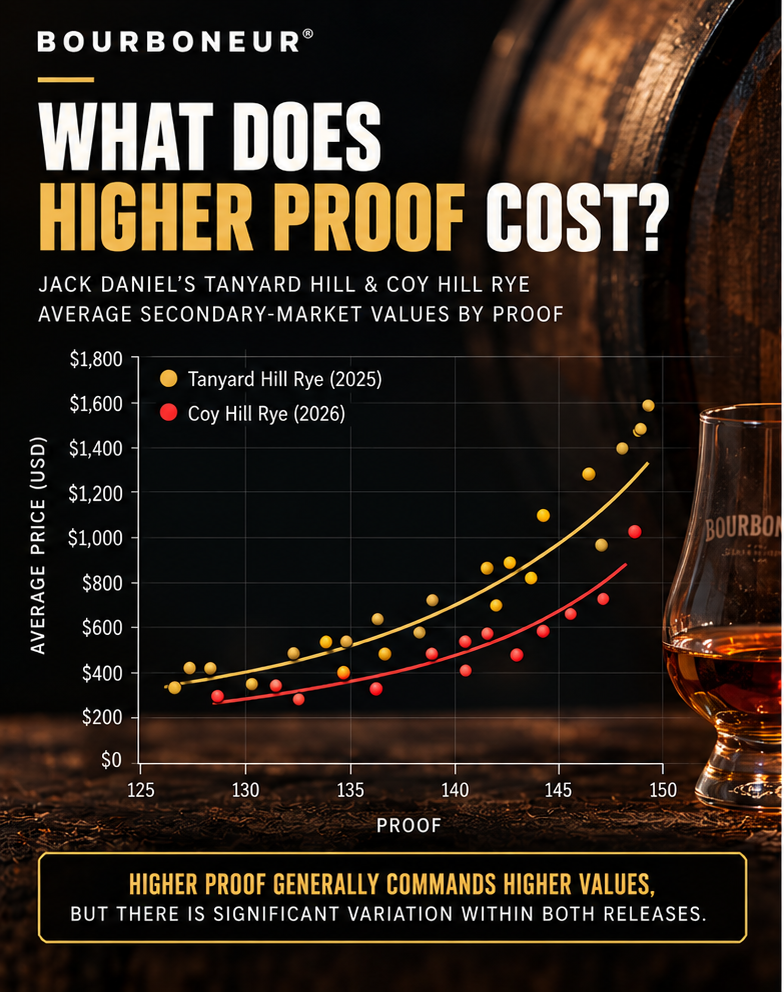
At that point, proof begins to function as more than a measure of alcohol content.
It becomes part of the bottle’s collectible identity.
Of course, higher proof doesn’t automatically translate to better whiskey. An exceptionally high-proof barrel may be fascinating to collectors without necessarily offering the most balanced drinking experience.
But the secondary market doesn’t always reward balance.
Sometimes it rewards rarity, extremes, and the distinction of owning something few other collectors can find.
Coy Hill enters this comparison with an advantage Tanyard Hill didn’t necessarily enjoy: an established reputation.
Previous Coy Hill releases helped make the name synonymous with some of Jack Daniel’s most sought-after high-proof whiskey.
That recognition naturally creates expectations for a new release carrying the same name.
But when we compare identical bottle proofs, the pricing becomes interesting.
At 133.8 proof, Tanyard Hill Rye averages $475, compared with $450 for Coy Hill Rye.
At 142.6 proof, the values are similarly close: $563 for Tanyard Hill and $550 for Coy Hill.
Move higher, however, and the relationship changes.
At 144.1 proof, Coy Hill averages $794 compared with $624 for Tanyard Hill. At 144.8 proof, Coy Hill averages $838 versus $758 for Tanyard Hill.
There is no uniform Coy Hill premium across these examples.
At some proofs, the releases trade at remarkably similar values. At others, Coy Hill commands a meaningful premium.
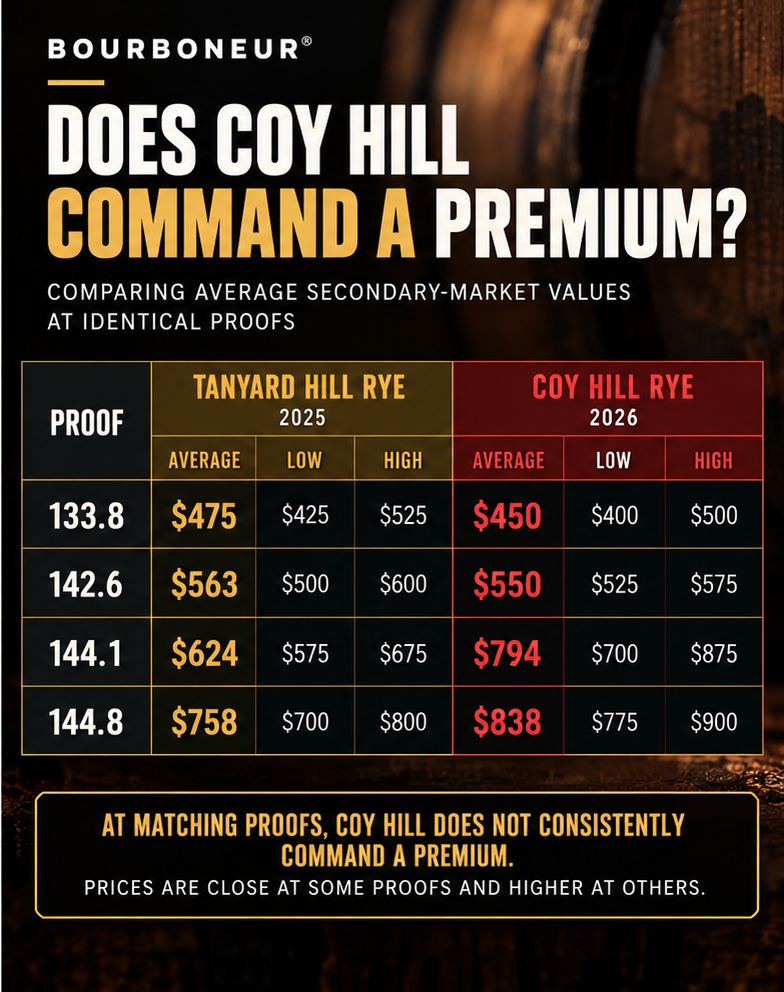
These comparisons are based on secondary-market observations tracked by Bourboneur. Our pricing methodology explains how market data is evaluated to establish bottle values.
This suggests that collectors may be weighing multiple factors simultaneously, including proof, release reputation, availability, and timing.
And timing is particularly important here.
Tanyard Hill Rye has had approximately a year to establish itself in the secondary market.
During that time, bottles have changed hands, collectors have developed preferences, and prices have had an opportunity to adjust as initial release excitement subsided.
Coy Hill Rye is only beginning that process.
Its earliest secondary-market transactions reflect the excitement and uncertainty that typically accompany a new limited release.
Based on current Bourbon Blue Book® observations, Coy Hill Rye averages range from $449 at 129.7 proof to $1,075 at 145.8 proof.
Tanyard Hill Rye, meanwhile, has several exceptionally high-proof expressions commanding averages above $1,200, with the 147.2-proof bottle averaging $1,567.
That doesn’t establish Tanyard Hill as the more valuable release.
The two datasets cover different stages of market maturity, and the currently observed Coy Hill expressions don’t extend as high in proof as the highest Tanyard Hill bottles.
But it does highlight an important distinction between release excitement and established market value.
A newly released bottle may command an immediate premium because collectors want to be among the first to own it. Whether that premium persists depends on supply, demand, and how the market responds as more bottles become available.
Tanyard Hill has already traveled much of that road.
Coy Hill is just getting started.
For someone planning to open the bottle, the answer may have relatively little to do with the secondary market.
Both releases offer nearly decade-old, barrel-proof Tennessee rye whiskey from a distillery with an established reputation for producing exceptional high-proof expressions.
Their individual flavor profiles, barrel characteristics, and proof levels may matter more than the location printed on the label.
For collectors, the calculation is different.
The Bourbon Blue Book® data demonstrates that proof can substantially influence value, particularly among the highest-proof expressions.
Yet the comparison also suggests that the Coy Hill name doesn’t automatically command a premium at every proof.
A collector seeking a particular proof may find that Tanyard Hill offers comparable characteristics at a lower secondary-market price. Another may prefer Coy Hill’s established reputation and historical significance.
Neither approach is inherently right or wrong.
What matters is understanding what you’re paying for.
Two hills. One distillery. The same rye mash bill. And prices that can differ by more than $1,000.
Jack Daniel’s Tanyard Hill and Coy Hill Rye offer a fascinating look at how maturation environments, barrel proof, and collector perception intersect.
The geography helps explain how these whiskeys develop their distinctive characteristics.
The proof helps explain why certain bottles attract substantially higher valuations.
And the secondary market reminds us that reputation, scarcity, and release timing can be just as influential as the whiskey itself.
Whether Coy Hill Rye ultimately follows Tanyard Hill’s pricing trajectory remains to be seen.
But one thing is already clear: when it comes to collectible whiskey, the name of the hill may get your attention.
The number on the bottle might determine the price.
For more insights into collectible whiskey values and emerging market trends, explore Bourboneur’s Market Intelligence coverage.
Market values referenced in this article are based on Bourbon Blue Book® observations available in October 2026. Values represent proof-specific averages and may change as additional market activity is recorded. Secondary-market observations are provided for informational purposes and do not constitute offers to buy or sell alcohol.